Kevin Solez
June 7, 2025
Kevin Solez reflects on the parallels between working with gems and ancient poetic texts while offering a new translation of Posidippus Lithika 7.
I have long loved peridot, the pale green, semiprecious gem that is surely the stone discussed in Posidippus Lithika 7, which appears below in a new translation. The geographic indications in the poem point in the direction of Egypt’s Zabargad Island in the Red Sea (confusingly called Topazos Island, but not rich in topaz, and also known as St. John’s Island). This is the world’s first identified source of the gemstone peridot (Pliny NH 37.108) and is not far from the Sarawat mountain range in Saudi Arabia, which may be the Arabian mountains mentioned in Lithika 7. My work with Posidippus’ poem occasioned this post that reflects on the interests that motivate students in Classics and presents a holistic view of a scholar’s life experience and professional practice.
My love of peridot began when I worked in a gem shop owned by a geologist who was also the Honorary Consul of Lebanon in Alberta, Samir Ghossein. I got this job while I was studying Classics at the University of Alberta, and it had the dual benefits of indulging my childhood love of rocks and fossils while giving me time to work on Greek and Latin (and on poetry). There were achingly beautiful pieces of tumbled and faceted peridot floating around that store, and I loved to touch and look at them. What else, after all, are gemstones for?
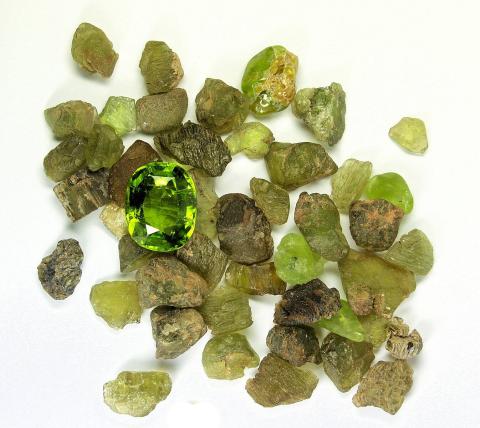
In my memory, spending time in that shop with those scintillating objects blends conceptually with reading Greek and Latin. Each becomes a source domain for the interpretation of the other. Thousands of stones and the imperishable remains of living things from all over the world—spanning millions of years, from Cambrian trilobites to rough gemstones just now pulled from the ground on prospecting expeditions—were there: motionless, palpable, and mere steps away. A page of the fascinating texts I was reading at the time, such as Philostratus’ Imagines, The Tablet of Cebes, Herodotus, Homer’s Odyssey, or Sallust’s Bellum Jugurthinum had a similar nature: coming from long ago, representing not one place in the world but many, and legible, appreciable, and understandable with no limit on the time one might spend with a single word, sentence, or stone besides the end of the shift.
That practice the Romans called lectio, reading a text governed by a metaphor of picking and selecting, suffused my reading and play with gemstones. I could pick up a gem and look at it from all angles, the way professors encourage in philology. If I didn’t know what the stone was, there were gemology books I could consult to measure my observations against ideal types the way I did with words in my Greek and Latin dictionaries.
I had a few years working there under my belt when I started grad school in 2004, and shortly thereafter learned of The New Posidippus from seeing Kathryn Gutzwiller’s book by that name in the “new books” section on D-Level of the Milton S. Eisenhower Library at Johns Hopkins. I pulled it off the shelf, saw Ann Kuttner’s and Peter Bing’s chapters on the Lithika, and decided to translate those gemological poems. That plan got put back on the shelf and remained for twenty years, but I pulled it down in early 2025.
Peridot (Lithika 7)
From Arabian mountains
to the sea,
the meltwater river
churning
the chartreuse till
bore this stone,
the colour of honey,
which Saturnian’s hand
carved: bezelled in gold…
It sparkles on the necklace chain
for Nikonoe…
and on her breast
on her fair skin
the honey-sweet light
dances.
Lithika 7, Column I, lines 30–35 (as printed in C. Austin and G. Bastianini, edd., Posidippi Pellaei Quae Supersunt Omnia. Milan: 2002)
ἐξ Ἀράβων τὰ ξάνθ’ ὀ̣[ρέων κατέρ]υτα κυλίων
εἰς ἅλα χειμάρρους ὦκ’ [ἐφόρει ποτα]μὸς
τὸν μέλιτι χροιὴν λίθ̣[ον εἴκελον, ὃ]ν Κρονίο[υ] χ̣εὶρ
ἔγλυψε· χρυσῶι σφι⟨γ⟩κτ̣[ ±11 ]ῆ̣ι
Νικονό̣η `ιʹ κάθεμα τρη[τὸν φλέγει, ἧ]ς̣ ἐπι μαστῶι
συλ⟨λ⟩άμπει λευκῶι χρω̣τὶ μελιχρὰ φάη.
The governing poetics of this translation are to make the diction, arrangement of ideas, and architecture of the lines flow from the telescopic to the microscopic, from the geographic to the erotic, with the stone itself (line 6 of the English and line 3 of the Greek) as the hinge of the piece. That conceptual blending I mentioned unites stone, λίθον, word, and object in an embodied lectio with a piece of peridot revolving conceptually and orthographically at the centre of both poems. The sensory-motor experience of seeing and handling the gems enlivens my engagement with the text and literally drew me to the poem the way a beautiful stone invites inspection. This is not to diminish the aesthetic and intellectual appeal of the work of Gutzwiller, Bing, and Kuttner, which also inspired my interest.
The sound and the feel of the words in the mouth from lines 1 to 5 are meant to mirror the churning mountain river. Once we get to the gem, the particularization goes from the stone, to the piece of jewellery in which it is set, to how it casts tiny rays of light on the skin of its wearer. Particularization creates the poetic effect of zooming in, found frequently in ekphrasis, and I manipulated the source material to keep the focus on the gem, the jewelry, and Nikonoe; the Greek also emphasizes the glyptic art of Kronios, but I have suppressed this aspect of the particularization by selecting the most familiar way to render the artist’s name for readers of English—Saturnian. The analysis of the human body into parts (the skin, the breast), which follows, is typical of an erotic gaze, and I try to capture that the enjoyment of the stone is not just the viewer’s but also Nikonoe’s. Representing some of the playfulness of the piece, I have made the final syllable of the second line of each stanza rhyme in a long e sound.
This is the second time my experience of gemology has inspired poetic work on Greco-Roman texts. In 2021, I published a poetic translation of an excerpt of Philostratus’ prose on the gemstone amber in Ancient Exchanges.
The Amber and the Poplar
And with the breeze and frost
that he gives off, Eridanus
will turn their tears to stone
and receive the falling pieces
beneath the surface.
Through the sparkling water
he will lead them away
to the barbarians in Ocean—
the ambers of the poplar.
Philostratus the Elder, Imagines, 1.11.5 (as printed in C.L. Kayser, ed., Flavii
Philostrati Opera, Vol. II. Leipzig: 1871):
[…] αὔραις γὰρ καὶ κρυμοῖς, οὓς ἀναδίδωσι, λιθουργήσει καὶ πεσόντα ὑποδέξεται καὶ διὰ φαιδροῦ τοῦ ὕδατος ἀπάξει τοῖς ἐν Ὠκεανῷ βαρβάροις τὰ τῶν αἰγείρων ψήγματα.
Looking at these two pieces together, I start to wonder what could be said generally about crystalline/gemological poetics/rhetoric in ancient Greek literature. Florid literary style meets with epigrammatic brevity in these two treatments of gems; the epigram’s ambit resembling the shifting eye of the ekphrasitic viewer/speaker in Philostratus. Gemstones that invite comment originate far away from the author’s place of articulation. In these cases, the gems are conceived of as coming from across the sea in Arabia (peridot) or from far to the north in modern-day Poland (the source for most Mediterranean amber).
With only two examples, my sample size is small. Small size, however, in a different sense, is part of the blended appeal of this material. Gems tend to be small, and their small size and ability to fascinate is part of their aesthetic appeal both to the eyes and to the sense of touch. Ancient literary engagements with them may partake of a similarly limited scope, attempting to ever so briefly dazzle the reader, and a larger study of gemological literature may be able to demonstrate that. Looking at my English poetic treatments, I can certainly say that they attempt to capture and mimic the sensory-motor experience of holding a dazzling gemstone.
Authors

|